
batting
7.1 Each team must have at least one female batter for every four consecutive batters (i.e. you may not have four consecutive male batters).
7.2 The batting order of each team must be on the score sheet prior to the start of the game and it is not to be changed or altered. (See Rule 4.9 for exception)
7.3 Each of the player names is to be written out, including all of the females (i.e.: If you have 6 men and 4 women, then there is to be 10 consecutive names written and to be followed with no rotating of the female names in the line up). Note: The only time rotating names in the line up can happen is when you do not have enough men/women to fulfill that "at least every fourth batter is a female” rule. All the males must be written in the lineup. Only the femaI’e rotate.. For this to occur the only situation is when more your team has than 3x the amount of male vs female present (examples: 10 male & 2 or 3 female; 9 male & 2 female, 8 male & 2 female)
7.4 Any player who plays a defensive position (fielder), must also bat. 7.5 Each batter must also assume a fielding position (at least 1 inning)
7.6 Team players who do not play as fielders during an inning are still eligible to bat in the same inning.
7.7 No bunting is allowed. Any batter who bunts is automatically out.
7.8 Any fairly hit ball which flies out of the field is an automatic home run. 7.9 Any fairly hit ball which bounces out of the field is a ground rule double.
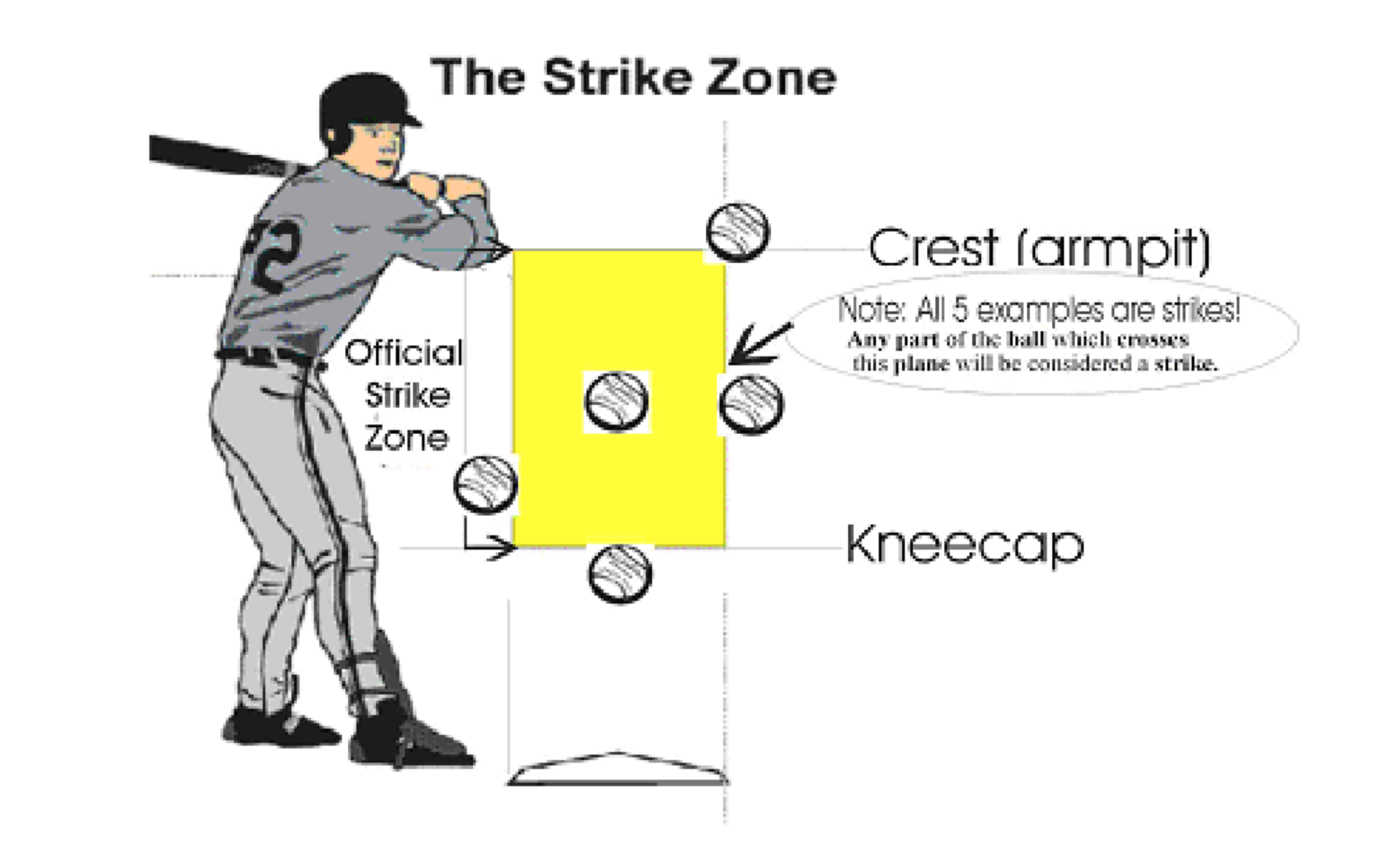
7.10 Strike Zone Strike zone consists of the width of the plate by the area between the batter’s knees and the letters on the batter’s shirt (from armpits to knee), while the batter assumes his/her natural batting stance. Any part of the ball which crosses this plane will be considered a strike.
8.1.1 If a batter/runner overruns first base, the batter may safely turn into the field and return directly to first base.
8.1.2 If the batter/runner begins to run towards second base, then the runner may be tagged out.
8.1.3 The batter cannot run to first on the third strike when the catcher drops the ball. The batter is out on strikes .
8.2 Runner (runner that was not the batter) on the base path
8.2.1 If a fielder is attempting to field a ball in the runner’s base path, the runner may safely break his/her base path to avoid interfering with the fielder’s play.
8.2.2 If the runner hits a fielder who is obstructing the runner’s base path while attempting to field the ball, the runner is out.
8.2.3 If a runner deviates more than three feet from the base path to avoid being tagged out, the runner is automatically out.
8.2.4 If a runner overtakes another runner, the overtaking runner is automatically out.
8.2.5 If two runners legally arrive at the same base, the runner who reached the base first shall be safe. The other runner may be tagged out until he/she legally reaches an unoccupied base.
8.3 THE FOLLOWING RULES APPLY TO THE DOUBLE BASE: (1st base safety bag)
8.3.1 A batted ball hitting the white portion is declared fair and a batted ball hitting only the orange portion is declared foul.
8.3.2 If a pitched ball is hit and the batter-runner fails to use the orange portion of the base on this first attempt at 1st base, and if a play is made, the batter-runner is out.
8:3.3 A defensive player must use ONLY the white portion of the base at all times to record an OUT. (No penalty for stepping on the orange bag)
8.3.4 AFTER OVER RUNNING THE BASE, THE BATTER-RUNNER MUST RETURN TO THE WHITE PORTION. 8.3.5 Should the batter-runner round the base on a hit through the infield or to the outfield, he must return to the white portion.
8.3.6 A batter approaching first base may touch either the white half or the orange half of first base, only if the defensive team makes no attempt to put the batter out at first base.
8.3.7 If a fielder has no play at first, he/she must vacate first base entirely and allow the batter to round first base on the inside corner of the white half of first base without obstruction. If any fielder who has no opportunity for a play at first obstructs the batter’s progress as the batter rounds first, the batter is safe and is awarded second base.
8.3.8 When tagging up on a fly ball, the white portion must be used.
8.3.9 On an attempted pick-off play, the runner must return to the white portion. NOTE: Once a runner returns to the white portion, should he/she stand on the orange only, it is considered not in contact with the base and the runner shall be called out if he or she: is tagged with the ball or leads off from the orange on a pitched ball. NOTE: The lines that define an area are part of that area.
8.4 Safety Line
8.4.1 SAFE LINE (CO-ED ONLY). A safe line is a line drawn in foul territory starting at the front corner of home plate closest to third base and perpendicular to the third base line. It shall extend 3.05 m (10 ft.) from third base line into foul territory. When a runner touches or crosses this line (i.e., one foot touching the ground) prior to a defensive player legally holding the ball while in contact with home plate the runner shall be declared safe. Any runner who touches home plate will be declared out. Exception: A runner shall not be called out if home plate is touched in an attempt to avoid a collision. Note: No fielder may tag a runner while the runner is in the safety zone. A runner who is tagged while in the safety zone, is automatically safe and scores a run.
8.4.2 The area along the third base line between the safety line and the back plate line is called the safety zone.
8.4.3 Once a runner places at least one foot in the safety zone, the runner must continue to the back plate line. If the runner retreats back across the safety line and out of the safety zone, the runner is out. Runners who have not crossed the line or runners who cross the line but must tag up on a caught fly ball, may return to third base or the base they originated from with liability to be put out, and the force play to return home plate is not in effect.
8.4.4 Once a runner places at least one foot in the safety zone, any fielder in possession of the ball need only touch home plate to put the runner out, even if the runner is not forced to home plate.
8.4.5 If a runner crosses and plants a foot or a body part on the ground pass the back plate line and before a fielder touches home plate, the runner is safe and scores a run, even though the runner did not touch the home plate.
8.4.6 If a runner touches home plate, attempts to touch home plate or steps directly over home plate while the ball is in play, the runner is out and does not score a run. Exception: If runner step on home plate to avoid a collision, the runner is safe!
8.4.7 No fielder may tag a runner while the runner is in the safety zone. A runner who is tagged while in the safety zone, is automatically safe and scores a run.
8.5 Sliding Runners may slide, as long as they do not slide aggressively. A runner who slides aggressively is automatically out. Note: Aggressive sliding also includes any deliberate interference with a defensive play as the runner approaches a base.
8.6 Overthrows
8.6.1 If a fielder throws the ball out of play, all runners automatically advance two bases from the point they were positioned when the fielder threw the ball. (The base they were going to, plus an additional base)
8.6.2 A ball remains in play while the ball is anywhere inside the field boundary. 8.7 Leading
8.7.1 No runner may lead from a base. A runner who leads is automatically out. Lead is define as “a runner foot leaves the base before the pitched ball crosses the plate”.
8.7.2 NO Anticipation - Runners may only leave their bases when the pitched ball is contacted. If the runners leave the base prior to the batter making contact with the ball, the runner is out.
8.7.3 Stealing is not permitted.
8.8 Fairly batted ball hitting a runner
8.8.1 If a fairly batted ball strikes the batter before the batter reaches first base, the batter is out and the ball is dead.
8.8.2 If a fairly batted ball strikes a runner other than the batter, while the runner is not touching a base before the ball passes by a fielder (other than the pitcher), the runner is out and the ball is dead. The batter-base runner advances to first and any base runner which are forced forward by him/her also take one base. The ball is dead. (note: No runs can score)